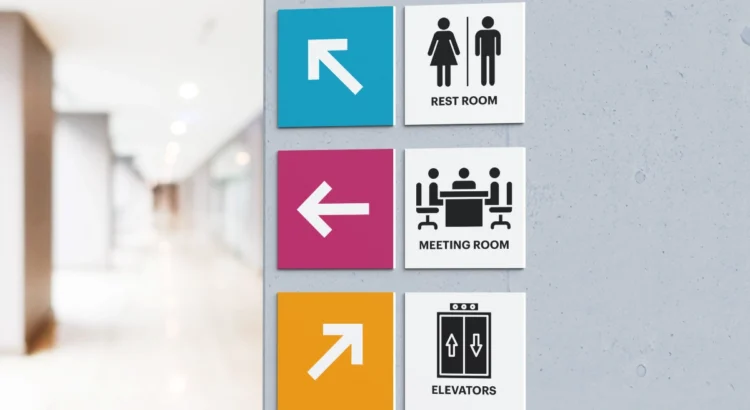
PVC signs are rigid yet lightweight signs that we offer in four thicknesses, from 3mm for indoor displays to 12mm for permanent outdoor signs, so you can match signs to your clients’ different needs. This guide explains how the thicknesses differ and how to choose the right one for your clients.
Read More: Top Rigid Sign Materials and Their Uses
What Are PVC Signs, and What Are Their Features?
PVC signs are made of polyvinyl chloride, a plastic also known as Sintra. The board has a smooth, matte white surface and resists flame, chemicals, and moisture. This makes them suitable for indoor displays and, in the thicker options, outdoor signs. The design is printed directly onto the board using full-colour digital printing with UV ink, which makes it resistant to fading, scratching, and moisture.
PVC Signs can be printed on one or both sides, finished with a coating, and cut into standard or custom shapes, so one product can cover many different client projects. Here’s what to know about each feature before you recommend PVC to a client.
Rigid, But Lightweight
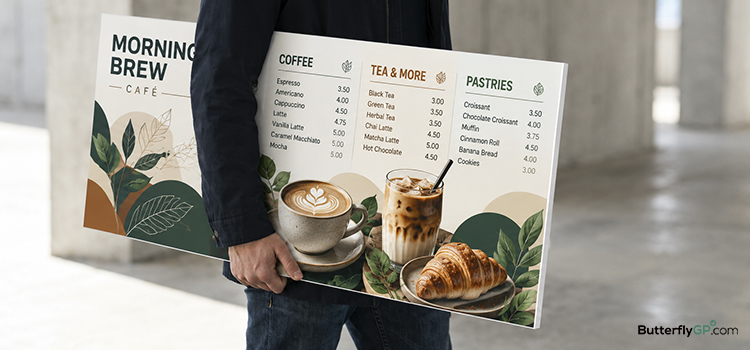
PVC holds its shape and resists bending, so a sign stays flat and steady once it’s up, yet it’s lightweight enough for carrying and handling easily. Weight increases with thickness, so the thinner boards are easier to move and install, while the thicker ones feel more solid for long-term use.
For your clients, that means signs that are easy to carry to a site. Grommets can be added to 3mm signs for fast and easy hanging.
Versatile and Easy to Customize
PVC signs are produced in standard and custom sizes, up to 60″ × 120″ for 3mm and 6mm and up to 48″ × 96″ for 10mm and 12mm. They can be cut into standard shapes or contour-cut to match a client’s design, and printed on one or both sides with a choice of coatings. That makes them suitable for a long list of uses, from retail displays and menu boards to storefront signs, job site signs, and dimensional (3D) letters. For you, that means one product can answer many client requests.
Sharp Print on a Smooth Surface
PVC has a smooth, matte white surface that takes full-colour digital printing well. The design is printed directly onto the board with UV ink, so colours come out vivid, and details stay sharp.
For your clients, that means clean, professional-looking signs with logos and text that are easy to read.

Available Sizes and Thickness Options
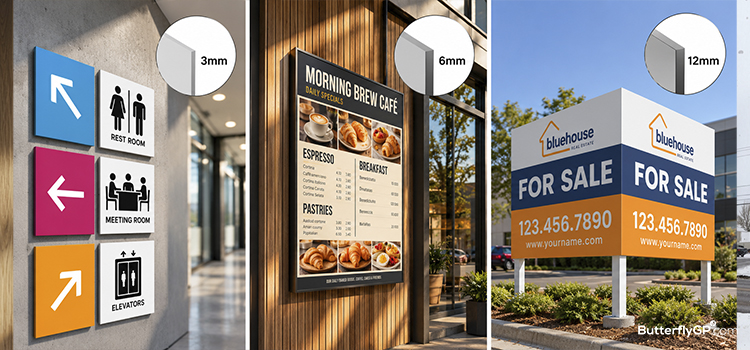
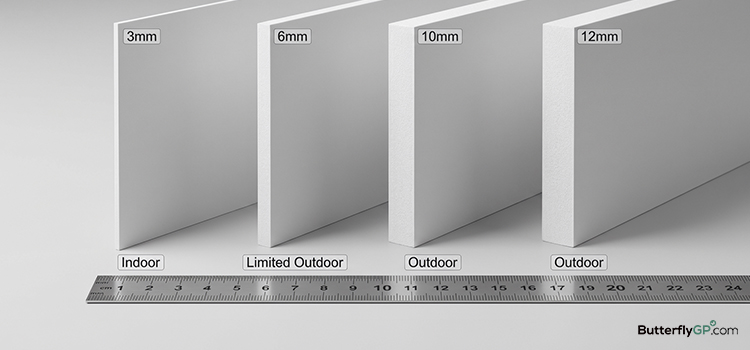
PVC signs are printed in four thicknesses, from 3mm to 12mm. Thicker boards are better for longer-term and outdoor use, so the thickness you recommend depends on where your client wants the sign to go and how long it needs to last.
- 3mm: Short- to medium-term indoor use, such as retail displays, trade show booths, wayfinding signs, menu boards, and short-term promotions. It’s the only thickness that takes grommets.
- 6mm: Medium-term indoor use and limited outdoor use, such as storefront signs, directional signs, office branding signs, and trade shows and events.
- 10mm: Long-term indoor and outdoor use, such as real estate signs, commercial signage, job site signs, outdoor promotional signs, and dimensional (3D) letters.
- 12mm: The thickest option, for permanent outdoor signs, roadside business signs, large commercial signage, long-term job site signs, and real estate signs.
Standard sizes (width x height) vary by thickness:
- 3mm: 6″ × 24″ up to 60″ × 120″
- 6mm: 18″ × 24″ up to 60″ × 120″
- 10mm and 12mm: 18″ × 24″ up to 48″ × 96″
Custom sizes are also available for every thickness, up to the maximum for that thickness.
Read More: Choosing the Right Outdoor Sign Materials: An Expert’s Guide
How to Choose the Right Thickness
Start with where the sign will hang and how long it needs to stay up. If your client wants to hang a sign indoors, 3mm is the lighter, more cost-effective option, and the only one that takes grommets.
For outdoor jobs, go with 10mm or 12mm, since 6mm suits only limited outdoor use and 3mm is indoor only. In short, thinner boards save weight and cost, and thicker boards give you the durability you need from a long-term outdoor sign.
Finishing Options to Raise with Your Clients
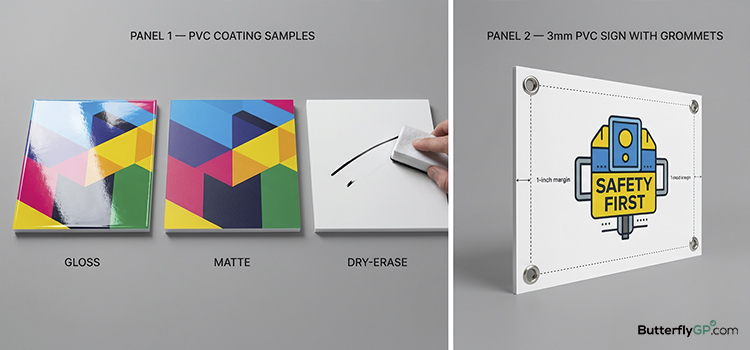
A PVC board starts with a matte surface, and a few finishing options can change how the sign looks, works and hangs. They’re worth raising with your clients:
- Coatings. Gloss film adds a shiny, reflective finish, and matte film gives a glare-free one. If the sign needs to be written on and wiped clean, choose dry-erase film or UV liquid lamination, which also adds a protective layer. With any film lamination (gloss, matte, or dry-erase), keep at least a 1-inch white margin on all sides of the artwork, so the film sticks better and lasts longer
- Grommets. They’re available on 3mm signs only and sit 1 inch in from the edge by default, so keep text and logos clear of those spots.
- Custom shapes. PVC signs can be contour cut to match a client’s design. Request a quote on our website or call our customer support team for help with artwork and pricing, and include a vector cut path in the artwork file.
Installation and Maintenance
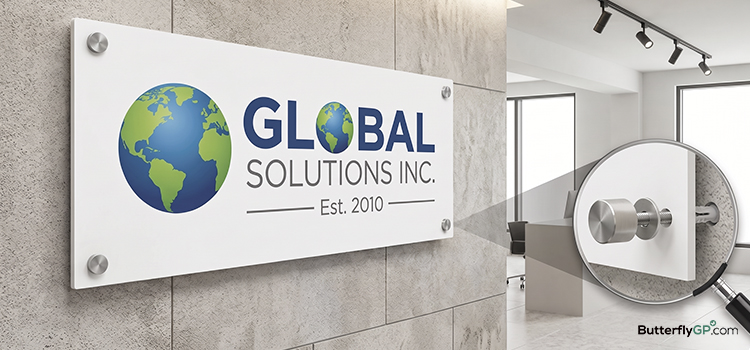
Installing and Caring for PVC Signs
The durability of a PVC sign depends on two things you can influence: the thickness you choose and how you install it. For outdoor use, 10mm and 12mm are the boards made for it; 6mm suits limited, short-term outdoor use with proper care and handling, and 3mm is for indoors only. Local weather and how the sign is handled also play a part, so we can’t consider a single lifespan for every PVC sign.
Installation is where jobs often go wrong, and one museum’s experience is a good example.
A staff member there hung two walls of PVC interpretive signs on drywall that had been painted a few weeks earlier, using foam mounting tape, a method that had worked for them on smaller signs. This time, most of the smaller signs held, but one 18″ x 24″ sign fell and broke a corner, and a row of narrow 60″ x 6″ title signs came down too.The largest signs stayed up mainly because of extra mirror clips, and even those had come loose from the wall in places. The room was humid and the building vibrated, and the sign that fell was the only one that had been repositioned during hanging, which the staff member suspected was the cause. Several replies in the Reddit discussion about mounting PVC signs recommended mechanical fasteners, such as French cleats screwed to the wall, over tape.
When to Recommend PVC Signs
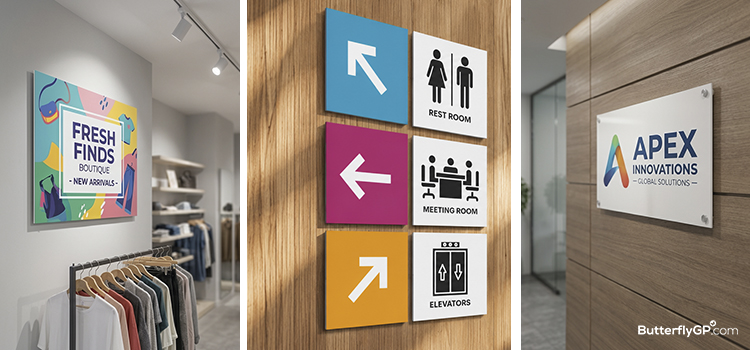
PVC signs are a good recommendation when your client needs a rather light rigid sign with a smooth surface for indoor or outdoor use. The right thickness depends on the job:
- Retail and short-term indoor jobs. Recommend 3mm for retail displays, menu boards, and short-term promotions. For a storefront sign, step up to 6mm, which also handles limited outdoor use.
- Real estate. Recommend 10mm or 12mm, which are built for long-term outdoor use.
- Commercial signage. Office branding signs suit 6mm. Large commercial signage, roadside business signs, and dimensional (3D) letters suit 10mm and 12mm.
PVC also works for trade show booths and events (3mm and 6mm), directional and wayfinding signs, and job site signs (10mm and 12mm). If a client wants a more affordable indoor option, Foam Board Signs may be the better option, and if they need something more durable, recommend Alupanel Signs.
For outdoor jobs in Canada, go thicker. Cold makes PVC more brittle, and a sign here can swing from deep winter cold to summer heat. The manufacturer of Sintra recommends 6mm or thicker for outdoor cold-weather signs with minimal framing, such as post signs, and it assumes outdoor surface temperatures from about -34°C in winter to 65°C in summer.
That’s one more reason to steer outdoor clients to 10mm or 12mm. Tell them to leave the sign room to move as well: a 96-inch sign can change length by about 8 mm over a 56°C swing, so holes should be slightly oversized and fasteners snug, not tight.
To see how PVC compares with the other rigid sign materials, read Top Rigid Sign Materials and Their Uses.
Read More: Effective Indoor Signs for Retail Stores: What Works and Why?
Quoting Your Next PVC Sign
The simplest way to choose a PVC sign is to ask your clients two questions: where will it hang, and how long does it need to last? A short-term indoor job points to 3mm, a longer indoor job or a storefront sign points to 6mm, and a sign that will stay outside, especially through a Canadian winter, calls for 10mm or 12mm. You can also add a suitable coating if your client’s project needs it.
When you’re ready to quote, ButterflyGP.com’s PVC Signs are available at reseller-only prices, with no minimum order quantity.
FAQ
What’s the best PVC thickness for outdoor use?
For PVC signs that will stay outside, choose 10mm or 12mm, which are made for long-term outdoor use. The 6mm board is suitable for limited outdoor use for a short time with proper care and handling, and 3mm is for indoor use only.
How long do PVC signs last in Canadian winters?
There’s no single lifespan, because it depends on the thickness, the local weather, and how the sign is handled and mounted. Cold makes PVC more brittle, so thicker boards are the safer choice for outdoor signs: 10mm or 12mm for anything that will stay up through the winter. Mounting the sign with a little room to expand and contract also helps it hold up through big temperature swings.
Can clients write on a PVC sign?
Yes, with the right coating. Dry-erase film lamination or UV liquid lamination gives the sign a surface that takes whiteboard markers and wipes clean, and dry-erase film is the more durable of the two.